Playing the Lute to a Cow (对牛弹琴)
- Ages 4–8
- English audio 2 min
- Mandarin audio 2 min
Playing the Lute to a Cow is a classic story from Chinese Idiom Stories for Kids, for children aged 4–8. This page has the English story with a native English narration (about 2 min), plus the Chinese version with Mandarin narration (about 2 min). Free to read and listen, no sign-up.
A master musician plays his finest tune to a cow, and the cow just chews. Then he plays the buzz of a mosquito and the cry of a calf, and her ears go up. The Chinese idiom story 对牛弹琴 in simple English and Chinese, with narration.
Tap any sentence in the story to start reading from there. It stops at the end.
A narrator, and a voice of its own for each character: Gong Mingyi, The Cow, The Cowherd Boy
Record about a minute of your voice, and every story here can be read to your child in it. Credits come back automatically if it fails.
Read Playing the Lute to a Cow
Long ago, a man called Gong Mingyi played the lute beautifully. When he played, birds flew down to listen.
One day he saw an old cow eating grass by a field. A cow must like good music too, he thought. So he sat down and played his finest tune.
The tune was fine and clever. But the cow did not even lift her head. "Moo."
A cowherd boy laughed. "Mr Gong, a cow can't understand such a hard tune!" Gong Mingyi frowned. "Then what does she like?" The boy said, "Try a sound she knows."
Gong Mingyi changed his playing. He made the strings buzz like a mosquito. He made them low like a calf calling for its mother.
Now the cow's ears went up. Her tail swished. She walked over and tilted her head. "Moo!" she said. She liked this one!
Gong Mingyi smiled. "So the cow does like music. I just had to play something she could understand."
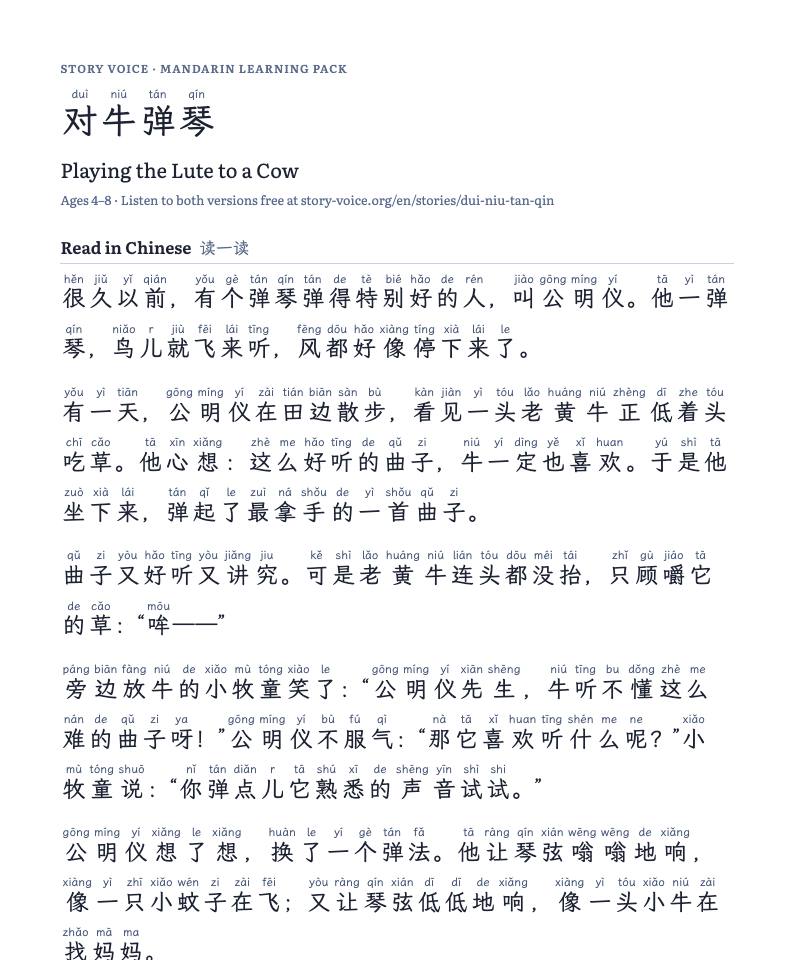
The Chinese version: 对牛弹琴
很久以前,有个弹琴弹得特别好的人,叫公明仪。他一弹琴,鸟儿就飞来听,风都好像停下来了。
有一天,公明仪在田边散步,看见一头老黄牛正低着头吃草。他心想:这么好听的曲子,牛一定也喜欢。于是他坐下来,弹起了最拿手的一首曲子。
曲子又好听又讲究。可是老黄牛连头都没抬,只顾嚼它的草:“哞——”
旁边放牛的小牧童笑了:“公明仪先生,牛听不懂这么难的曲子呀!”公明仪不服气:“那它喜欢听什么呢?”小牧童说:“你弹点儿它熟悉的声音试试。”
公明仪想了想,换了一个弹法。他让琴弦嗡嗡地响,像一只小蚊子在飞;又让琴弦低低地响,像一头小牛在找妈妈。
这下,老黄牛的耳朵竖了起来,尾巴一甩一甩,还迈着小步走到琴边,歪着头听。它冲着公明仪叫了一声:“哞!”这个,它听得懂。
公明仪笑了:“原来不是牛不爱听,是我没有弹它听得懂的曲子呀。”后来,人们就用对牛弹琴来说对听不懂的人讲道理。它也提醒我们:说话呀,要看对方听不听得懂。
Playing the Lute to a Cow (对牛弹琴): the moral of the story
Words only count when the listener can understand them. If someone doesn’t get it, try saying it their way.
- What does Playing the Lute to a Cow mean?
- Literally “to (对, duì) a cow (牛, niú) play (弹, tán) the qin (琴, qín).” It describes explaining something to a listener who cannot follow it, so the effort is wasted; the English “casting pearls before swine” is close. It also reminds the speaker to suit the words to the listener.
- Example sentence
- Ming tried to teach his little brother the times tables, but the boy had only just started nursery. Mum said that was 对牛弹琴 (duì niú tán qín), and he should start with counting.
The original Chinese text of Playing the Lute to a Cow
公明仪为牛弹清角之操,伏食如故。非牛不闻,不合其耳矣。转为蚊虻之声,孤犊之鸣,即掉尾奋耳,蹀躞而听。
— 汉·牟融《理惑论》
Our translation
Gong Mingyi played the refined Qingjiao tune for a cow, but the cow went on grazing as before. It was not that the cow did not hear; the music did not suit its ears. When he changed to the whine of mosquitoes and gnats and the cry of a lonely calf, the cow flicked its tail, pricked up its ears, and stepped about to listen.
— Mouzi, Lihuolun (late 2nd century)
Chinese words in Playing the Lute to a Cow
Play the Chinese narration and listen for these words. The pinyin shows the tones.
对牛弹琴duì niú tán qín
play the qin to a cow
弹琴tán qín
play the qin, a stringed instrument
牛niú
cow
曲子qǔ zi
tune
蚊子wén zi
mosquito
小牛xiǎo niú
calf
耳朵ěr duo
ear
听得懂tīng de dǒng
can understand
For families learning Mandarin
Mandarin learning pack
Print the story, read it together, then listen and say it back. Made for heritage families and children learning Mandarin.
- A printable PDF (3 pages): the Chinese story with pinyin over every character, the words to know, the English version, questions to talk about, and character writing practice.
- Slow Mandarin audio (4 min): every sentence at a gentler pace, followed by a pause long enough to say it back.
Buy once, download again any time. The story itself stays free to read and hear. Try the free sample pack (The Tortoise and the Hare) first.
Bedtime storytelling tips
- Hum a slow, fancy tune for Gong Mingyi’s first piece, then give the cow a lazy, bored “Moo.” Children love the contrast.
- For the second try, buzz like a mosquito and moo like a calf, and let your child guess whether the cow will look up this time.
- Afterwards ask: “Do you talk to a baby the same way you talk to Grandpa?” In Chinese, cow is 牛 (niú) and to play a stringed instrument is 弹琴 (tán qín).
Things to talk about afterwards
- What was the cow doing while Gong Mingyi played his finest tune?
- What sounds did he play so that the cow finally listened?
- Have you ever explained something and nobody understood? How else could you say it?
Read this story to your child in your own voice
- Record your voice and confirm it's really you
- Pick any story, in English or Chinese
- A few minutes later, hear it in your voice; you can also download the MP3
From about $1.05 a story, or $1.99 for a first-order taster. Reading and listening are always free, and failed generations are refunded.
Playing the Lute to a Cow (对牛弹琴): common questions
- What does the Chinese idiom 对牛弹琴 mean?
- 对牛弹琴 (duì niú tán qín) means “playing the qin to a cow.” It describes explaining something to someone who cannot follow it, a waste of effort, like “casting pearls before swine” in English. It is also a reminder to speak in a way your listener can understand.
- What is the moral of Playing the Lute to a Cow?
- The cow wasn’t deaf; the music just wasn’t for her ears. When the musician played sounds she knew, she listened. So when someone doesn’t understand you, change how you say it.
- Where does 对牛弹琴 come from?
- From the Lihuolun by Mou Rong (Mouzi), a late Eastern Han text from around the end of the 2nd century, which uses the story of the musician Gong Mingyi and the cow to explain why teachings must suit their listeners.
- Is there a Chinese version of Playing the Lute to a Cow?
- Yes. It is called 对牛弹琴 (duì niú tán qín). This page has our Chinese retelling with Mandarin narration next to the English one, and the classical original with a translation.
Source and how we retold it
From the Lihuolun (理惑论, “Treatise Settling Doubts”) by Mou Rong, also called Mouzi, written at the end of the Eastern Han around the late 2nd century and preserved in the Hongmingji; the original is in the public domain. The original is only a few lines. We expanded it into a story for children, added the cowherd boy who points out that the cow can’t follow a hard tune, and ended with Gong Mingyi working out for himself that he must play what the listener understands. Today the idiom is mostly used to mock the listener; our ending turns it round.
The narration on this page is AI-generated: the English is read by our narrator and the Chinese by our narrator. The audio files are labeled as AI-generated.
If you liked Playing the Lute to a Cow (对牛弹琴), there are more stories in Chinese Idiom Stories for Kids. You can also read this one to your child in your own voice.
More Chinese Idiom Stories for Kids
- Chinese Idiom Stories for KidsAges 4-82 min
Marking the Boat to Find the Sword刻舟求剑
A man drops his sword into a river, cuts a mark on the moving boat, and jumps in under the mark once the boat lands. The idiom story 刻舟求剑 in English and Chinese, with narration.
- Chinese Idiom Stories for KidsAges 4-82 min
The Fox Borrows the Tiger's Power狐假虎威
A tiger catches a fox, and the fox claims Heaven made him king of the animals. He walks ahead, the tiger follows, and every animal runs. The idiom story 狐假虎威 in English and Chinese, with narration.
- Chinese Idiom Stories for KidsAges 4-82 min
Mending the Pen After Losing a Sheep亡羊补牢
A shepherd loses a sheep through a hole in his pen but won’t fix it. When a second sheep goes, he mends it at once. The idiom story 亡羊补牢 in English and Chinese, with narration.
- Chinese Idiom Stories for KidsAges 4-82 min
Drawing Legs on a Snake画蛇添足
Helpers race to draw a snake for a pot of honey water. The fastest one finishes, then adds feet to his snake and loses the prize. The idiom story 画蛇添足 in English and Chinese, with narration.
- Chinese Idiom Stories for KidsAges 4-82 min
Waiting by the Tree Stump守株待兔
A farmer gets a free rabbit when it runs into a tree stump, so he stops working and waits by the stump for another. The idiom story 守株待兔 in English and Chinese, with narration.
- Chinese Idiom Stories for KidsAges 4-82 min
The Frog in the Well井底之蛙
A little frog thinks his shallow well is the best place in the world, until a big sea turtle tells him how vast the sea is. The idiom story 井底之蛙 in English and Chinese, with narration.