Kuafu Chases the Sun (夸父追日)
- Ages 4–8
- English audio 2 min
- Mandarin audio 2 min
Kuafu Chases the Sun is a classic story from Chinese Myths and Legends for Kids, for children aged 4–8. This page has the English story with a native English narration (about 2 min), plus the Chinese version with Mandarin narration (about 2 min). Free to read and listen, no sign-up.
The giant Kuafu runs after the sun, drinks two rivers dry and lies down to rest, and his staff grows into a forest of peach trees. A Chinese myth from the Shanhaijing in simple English with narration, plus the Chinese version in Mandarin.
Tap any sentence in the story to start reading from there. It stops at the end.
A narrator, and a voice of its own for each character: Kuafu, The Sun, Old villager
Record about a minute of your voice, and every story here can be read to your child in it. Credits come back automatically if it fails.
Read Kuafu Chases the Sun
Long ago, a giant named Kuafu lived in the north. One step took him across a river.
Every evening the sun went down and the village grew dark. Kuafu said, "I will catch the sun and bring it back!" An old man laughed. "The sun is fast. Can you catch it?"
Kuafu took his stick and ran after the sun, over mountains and grasslands. The sun smiled. "Come on! Catch me if you can!"
Kuafu got closer and closer. The sun was a ball of fire, and his mouth was dry. He drank up the Yellow River, then the Wei River. He was still thirsty.
He walked north to find a great lake, but he was too tired. He lay down under a tree. "I will rest a little," he said softly. He fell asleep and never got up.
His stick fell to the ground and slowly grew into a forest of peach trees. Now tired travellers rest in its shade and eat sweet peaches. It is Kuafu's gift.
The Chinese version: 夸父追日
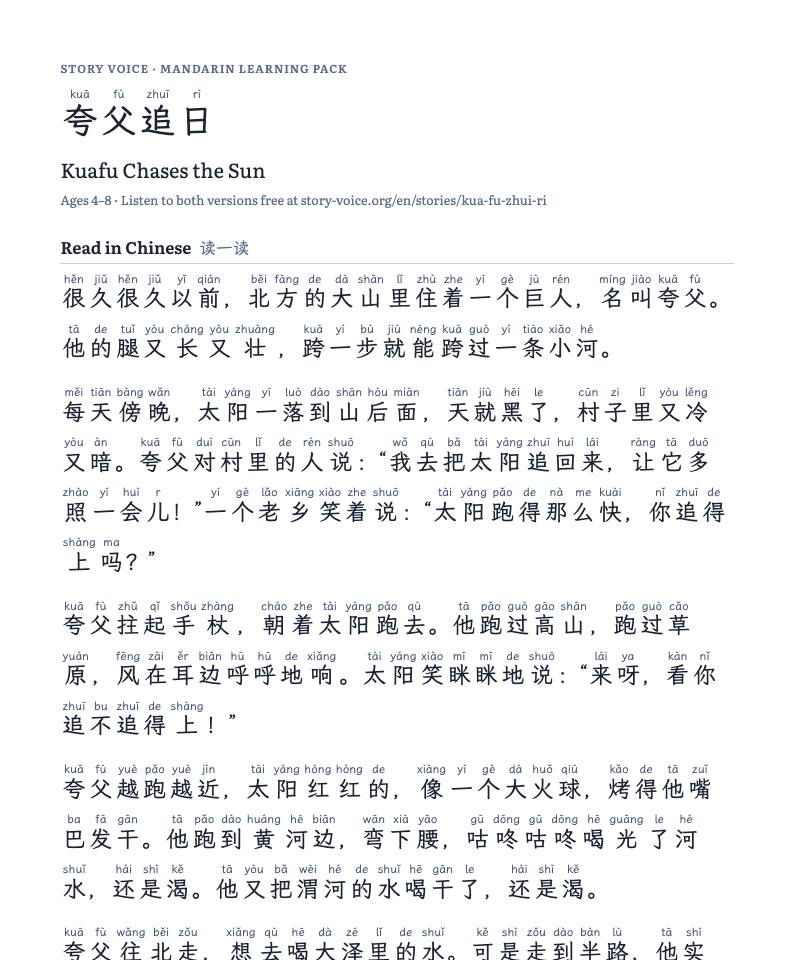
很久很久以前,北方的大山里住着一个巨人,名叫夸父。他的腿又长又壮,跨一步就能跨过一条小河。
每天傍晚,太阳一落到山后面,天就黑了,村子里又冷又暗。夸父对村里的人说:“我去把太阳追回来,让它多照一会儿!”一个老乡笑着说:“太阳跑得那么快,你追得上吗?”
夸父拄起手杖,朝着太阳跑去。他跑过高山,跑过草原,风在耳边呼呼地响。太阳笑眯眯地说:“来呀,看你追不追得上!”
夸父越跑越近,太阳红红的,像一个大火球,烤得他嘴巴发干。他跑到黄河边,弯下腰,咕咚咕咚喝光了河水,还是渴。他又把渭河的水喝干了,还是渴。
夸父往北走,想去喝大泽里的水。可是走到半路,他实在太累了。他在一棵树下躺下来,轻轻地说:“我先歇一会儿。”他就这样睡着了,再也没有起来。
他的手杖落在地上,慢慢地长出了嫩芽,长成了一大片桃树林。后来,每一个走累了的人,都能在树下乘凉,摘一个甜甜的桃子吃。人们说,那是夸父留下的礼物。
Kuafu Chases the Sun (夸父追日): the moral of the story
Chasing a big dream is brave, even if you never catch it. What you leave behind on the way can make life better for others.
The original Chinese text of Kuafu Chases the Sun
夸父与日逐走,入日。渴,欲得饮,饮于河、渭;河、渭不足,北饮大泽。未至,道渴而死。弃其杖,化为邓林。
— 《山海经·海外北经》
Our translation
Kuafu raced with the sun and ran right into it. He was thirsty and wanted a drink, so he drank from the Yellow River and the Wei River. They were not enough, so he went north to drink from the Great Marsh. Before he got there, he died of thirst on the road. He threw down his staff, and it became the Deng Forest.
— Classic of Mountains and Seas, “Regions Beyond the Seas: North” (Warring States to Western Han, c. 4th–1st century BC)
Chinese words in Kuafu Chases the Sun
Play the Chinese narration and listen for these words. The pinyin shows the tones.
夸父kuā fù
Kuafu, the giant
巨人jù rén
giant
太阳tài yáng
the sun
追zhuī
to chase
渴kě
thirsty
手杖shǒu zhàng
walking stick
桃树táo shù
peach tree
礼物lǐ wù
gift
For families learning Mandarin
Mandarin learning pack
Print the story, read it together, then listen and say it back. Made for heritage families and children learning Mandarin.
- A printable PDF (3 pages): the Chinese story with pinyin over every character, the words to know, the English version, questions to talk about, and character writing practice.
- Slow Mandarin audio (4 min): every sentence at a gentler pace, followed by a pause long enough to say it back.
Buy once, download again any time. The story itself stays free to read and hear. Try the free sample pack (The Tortoise and the Hare) first.
Bedtime storytelling tips
- Read the chase faster and louder as Kuafu gets closer to the sun, then slow right down at “He drank up the Yellow River.” Let your child say “still thirsty” with you.
- Make the last two paragraphs the quietest part of the story. Say “I will rest a little” with a small yawn and let your voice drift off; it is a natural lead-in to sleep.
- For families learning Chinese, the two words to try are 太阳 (tài yáng), the sun, and 桃子 (táo zi), peach. Next time you eat a peach, think of Kuafu together.
Things to talk about afterwards
- Why did Kuafu want to catch the sun?
- Which two rivers did Kuafu drink up? Was he still thirsty?
- Kuafu never caught the sun. Do you think he failed? What did he leave behind?
Read this story to your child in your own voice
- Record your voice and confirm it's really you
- Pick any story, in English or Chinese
- A few minutes later, hear it in your voice; you can also download the MP3
From about $1.05 a story, or $1.99 for a first-order taster. Reading and listening are always free, and failed generations are refunded.
Kuafu Chases the Sun (夸父追日): common questions
- What is the moral of Kuafu Chases the Sun?
- It is brave to chase a big dream, even one you may never catch. Kuafu never reaches the sun, but the peach forest that grows from his staff gives shade and fruit to everyone who comes after him. Trying hard leaves something good behind, even when you don’t get there.
- Where does the story of Kuafu come from?
- From the Classic of Mountains and Seas (Shanhaijing), chapter “Regions Beyond the Seas: North,” a collection of geography and myth compiled between the 4th and 1st centuries BC. The whole story is one short passage; the Liezi tells a similar version. Kuafu is one of the best-known figures of Chinese myth, and 夸父追日 is used today for anyone who takes on a task far bigger than themselves.
- Did Kuafu die in the original story?
- Yes. In the Shanhaijing, Kuafu dies of thirst before he reaches the great lake, and his staff becomes a forest called Denglin, which later readers took to be a peach forest. In our bedtime version he lies down to rest under a tree and never gets up, and the forest gives shade and fruit to tired travellers.
- Is there a Chinese version of Kuafu Chases the Sun?
- Yes. It is called 夸父追日 (Kuā fù zhuī rì). This page has our Chinese retelling with Mandarin narration next to the English one, and the classical original from the Shanhaijing.
Source and how we retold it
From the Classic of Mountains and Seas (Shanhaijing), chapter “Regions Beyond the Seas: North” (海外北经), compiled between the Warring States period and the Western Han dynasty (roughly 4th to 1st century BC); the original is only about forty characters long and is in the public domain. We retold it for children, adding Kuafu’s words to the villagers and the sun’s teasing reply. In the original, Kuafu dies of thirst on the road; here he lies down to rest and never gets up, and we added the travellers who rest in the shade of the peach forest that grew from his staff.
The narration on this page is AI-generated: the English is read by our narrator and the Chinese by our narrator. The audio files are labeled as AI-generated.
If you liked Kuafu Chases the Sun (夸父追日), there are more stories in Chinese Myths and Legends for Kids. You can also read this one to your child in your own voice.
More Chinese Myths and Legends for Kids
- Chinese Myths and Legends for KidsAges 3-72 min
Pangu Separates Sky and Earth盘古开天地
Before there was a world, there was an egg, and inside it slept the giant Pangu. He splits the egg with his axe, holds up the sky for eighteen thousand years, and becomes the sun, the moon and the mountains. A Chinese creation myth in simple English with narration, plus the Chinese version in Mandarin.
- Chinese Myths and Legends for KidsAges 3-62 min
The Nian Monster and the New Year年兽的故事
Every New Year's Eve the monster Nian comes down from the mountains, until an old man shows a village that it fears red, fire and loud noise. The legend behind red paper, lanterns and firecrackers, in simple English with narration, plus the Chinese version in Mandarin.
- Chinese Myths and Legends for KidsAges 3-61 min
Chang'e Flies to the Moon嫦娥奔月
Hou Yi is given a magic pill, and when a thief comes for it, his wife Chang'e swallows it and floats up to the moon. The legend behind the Mid-Autumn Festival in simple English with narration, plus the Chinese version in Mandarin.
- Chinese Myths and Legends for KidsAges 4-82 min
The Cowherd and the Weaver Girl牛郎织女
A kind cowherd marries a fairy who weaves the clouds, until the Queen Mother of Heaven draws a river of stars between them. Once a year the magpies build a bridge so they can meet. China's star-crossed love legend in simple English with narration, plus the Chinese version.
- Chinese Myths and Legends for KidsAges 3-72 min
Jingwei Fills the Sea精卫填海
A little princess is carried away by the waves and becomes a small bird, Jingwei, who drops twigs and stones into the sea every day to fill it up. A Chinese myth about never giving up, in simple English with narration, plus the Chinese version.
- Chinese Myths and Legends for KidsAges 4-82 min
Cao Chong Weighs the Elephant曹冲称象
Nobody at court can weigh the huge elephant, until six-year-old Cao Chong puts it on a boat, marks the waterline and weighs stones instead. A true story from the Records of the Three Kingdoms, in simple English with narration, plus the Chinese version in Mandarin.