The Cowherd and the Weaver Girl Story
- Ages 4–8
- English audio 2 min
- Mandarin audio 3 min
The Cowherd and the Weaver Girl is a classic story from Chinese Myths and Legends for Kids, for children aged 4–8. This page has the English story with a native English narration (about 2 min), plus the Chinese version with Mandarin narration (about 3 min). Free to read and listen, no sign-up.
A kind cowherd marries a fairy who weaves the clouds, until the Queen Mother of Heaven draws a river of stars between them. Once a year the magpies build a bridge so they can meet. China's star-crossed love legend in simple English with narration, plus the Chinese version.
Tap any sentence in the story to start reading from there. It stops at the end.
A narrator, and a voice of its own for each character: the Cowherd, the Weaver Girl, the Old Ox, the Queen Mother
Record about a minute of your voice, and every story here can be read to your child in it. Credits come back automatically if it fails.
Read The Cowherd and the Weaver Girl
Long ago, a young cowherd lived alone with an old ox, and he was kind to it.
One day the ox spoke. "Tomorrow the Weaver Girl will come to the river. Go and be her friend," it said.
By the river, the cowherd met the Weaver Girl. She could weave clouds. They got married and had two children. "I like it here better than the sky," she said.
But the Queen Mother of Heaven was angry and took the Weaver Girl back. "Climb on my back. I can fly!" said the ox.
"Wait for me!" the cowherd called. But the Queen Mother drew a line with her hairpin. "You may never meet again!" A river of stars ran between them.
The magpies felt sorry for them. Every year, on the seventh night of the seventh month, they make a bridge so the two can meet.
On a summer night, look up at the Milky Way. The bright stars on each side are the cowherd and the Weaver Girl.
The Chinese version: 牛郎织女
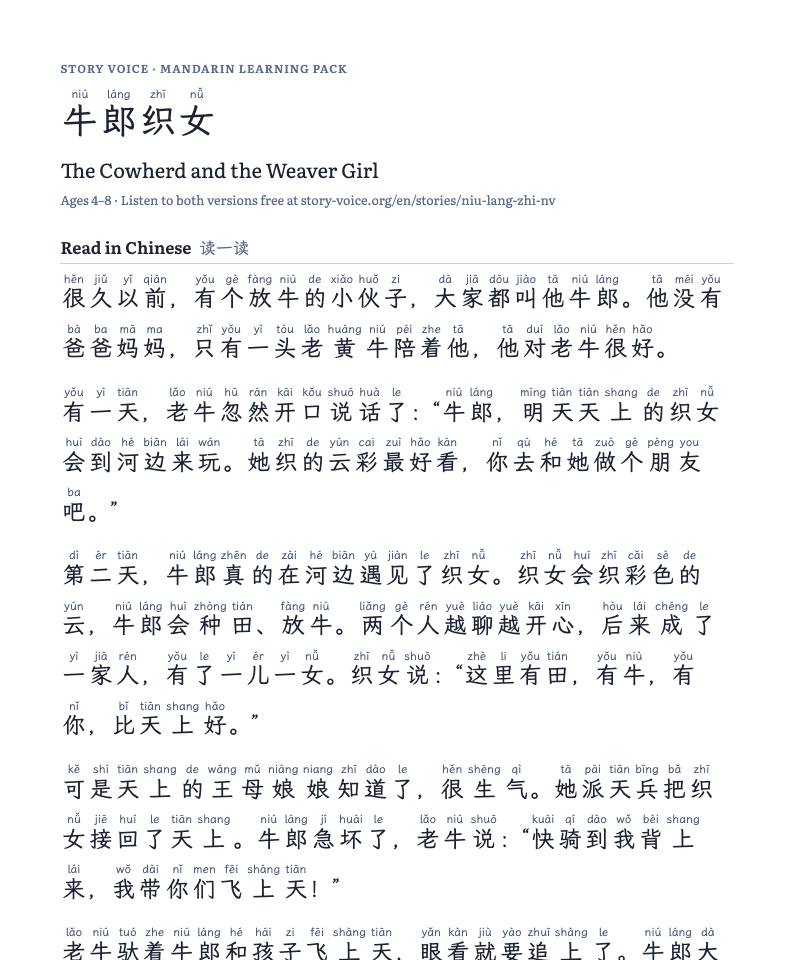
很久以前,有个放牛的小伙子,大家都叫他牛郎。他没有爸爸妈妈,只有一头老黄牛陪着他,他对老牛很好。
有一天,老牛忽然开口说话了:“牛郎,明天天上的织女会到河边来玩。她织的云彩最好看,你去和她做个朋友吧。”
第二天,牛郎真的在河边遇见了织女。织女会织彩色的云,牛郎会种田、放牛。两个人越聊越开心,后来成了一家人,有了一儿一女。织女说:“这里有田,有牛,有你,比天上好。”
可是天上的王母娘娘知道了,很生气。她派天兵把织女接回了天上。牛郎急坏了,老牛说:“快骑到我背上来,我带你们飞上天!”
老牛驮着牛郎和孩子飞上天,眼看就要追上了。牛郎大喊:“织女,等等我!”王母拔下头上的金簪,在天上一划:“你们不能再见面了!”一条宽宽的银河挡在了中间。
牛郎和织女隔着银河,只能远远地望着对方。喜鹊们都被感动了。每年七月初七,它们飞到天上,一只挨着一只,搭成一座鹊桥,让两个人在桥上见面。
夏天的晚上抬头看,银河两边各有一颗亮亮的星,就是牛郎星和织女星。听说七夕的夜里,葡萄架下还能听见他们说悄悄话呢。
The Cowherd and the Weaver Girl Story: the moral of the story
Kindness comes back to you: the old ox helps the boy who was good to it, and every magpie in the world lends a wing. Love finds a way, even across a river of stars.
The original Chinese text of The Cowherd and the Weaver Girl
迢迢牵牛星,皎皎河汉女。……盈盈一水间,脉脉不得语。
— 《古诗十九首·迢迢牵牛星》
Our translation
Far, far away, the Cowherd Star; bright, bright, the girl beside the River of Heaven. ... Only one clear stream lies between them, and they gaze at each other, unable to say a word.
— Nineteen Old Poems, “Far, far away, the Cowherd Star” (Eastern Han, 2nd century AD)
Chinese words in The Cowherd and the Weaver Girl
Play the Chinese narration and listen for these words. The pinyin shows the tones.
牛郎niú láng
cowherd
织女zhī nǚ
Weaver Girl
老牛lǎo niú
old ox
银河yín hé
Milky Way
喜鹊xǐ què
magpie
鹊桥què qiáo
magpie bridge
七夕qī xī
Qixi, the seventh night
星星xīng xing
star
For families learning Mandarin
Mandarin learning pack
Print the story, read it together, then listen and say it back. Made for heritage families and children learning Mandarin.
- A printable PDF (4 pages): the Chinese story with pinyin over every character, the words to know, the English version, questions to talk about, and character writing practice.
- Slow Mandarin audio (5 min): every sentence at a gentler pace, followed by a pause long enough to say it back.
Buy once, download again any time. The story itself stays free to read and hear. Try the free sample pack (The Tortoise and the Hare) first.
Bedtime storytelling tips
- Give the ox a slow, deep voice and the Queen Mother a cold one. Children pick out who is speaking at once.
- When the magpies make their bridge, let your child link their fingers together to build one.
- On a summer night, find the Milky Way and the two bright stars on either side: Altair is the cowherd, Vega is the Weaver Girl. In Chinese they are 牛郎星 (niú láng xīng) and 织女星 (zhī nǚ xīng).
Things to talk about afterwards
- How did the old ox help the cowherd?
- Why did the Queen Mother separate the couple? Do you think that was fair?
- Why do you think the magpies come back every year?
Read this story to your child in your own voice
- Record your voice and confirm it's really you
- Pick any story, in English or Chinese
- A few minutes later, hear it in your voice; you can also download the MP3
From about $1.05 a story, or $1.99 for a first-order taster. Reading and listening are always free, and failed generations are refunded.
The Cowherd and the Weaver Girl Story: common questions
- What is the story of The Cowherd and the Weaver Girl?
- A poor cowherd, helped by his old ox, meets and marries the Weaver Girl, a fairy who weaves the clouds. The Queen Mother of Heaven takes her back and draws the Milky Way between them with her hairpin. Every year, on the seventh night of the seventh month, magpies form a bridge across the river of stars so the two can meet.
- What is the Qixi Festival?
- Qixi (七夕, “the night of sevens”) falls on the seventh day of the seventh lunar month, in July or August. It is the night the cowherd and the Weaver Girl meet on the magpie bridge, and it is often called Chinese Valentine's Day. Girls used to thread needles under the stars that night to ask the Weaver Girl for skilful hands.
- Which stars are the cowherd and the Weaver Girl?
- The cowherd is Altair and the Weaver Girl is Vega, on opposite sides of the Milky Way. With Deneb they make the Summer Triangle, easy to spot on a summer night. The two small stars next to Altair are said to be the couple's children.
- Is there a Chinese version of The Cowherd and the Weaver Girl?
- Yes. It is called 牛郎织女 (Niú Láng Zhī Nǚ), “the cowherd and the weaving girl.” This page has our Chinese retelling with Mandarin narration next to the English one.
Source and how we retold it
The Cowherd and the Weaver Girl were first the names of two stars, mentioned in the Book of Songs (Shijing, “Da Dong”, roughly 1000–600 BC). The Eastern Han poem “Far, far away, the Cowherd Star”, one of the Nineteen Old Poems (2nd century AD), is the earliest surviving version that makes them a couple kept apart by the River of Heaven. The talking ox, the Queen Mother's hairpin, the magpie bridge and the meeting on the seventh night of the seventh month were added by folk tradition over the following centuries; the legend has no single author. All of these sources are in the public domain. For bedtime we left out the cowherd taking the fairy's clothes and the ox dying so that he can wear its hide; here the ox simply carries the family up to the sky.
The narration on this page is AI-generated: the English is read by our narrator and the Chinese by our narrator. The audio files are labeled as AI-generated.
If you liked The Cowherd and the Weaver Girl Story, there are more stories in Chinese Myths and Legends for Kids. You can also read this one to your child in your own voice.
More Chinese Myths and Legends for Kids
- Chinese Myths and Legends for KidsAges 3-72 min
Jingwei Fills the Sea精卫填海
A little princess is carried away by the waves and becomes a small bird, Jingwei, who drops twigs and stones into the sea every day to fill it up. A Chinese myth about never giving up, in simple English with narration, plus the Chinese version.
- Chinese Myths and Legends for KidsAges 4-82 min
Cao Chong Weighs the Elephant曹冲称象
Nobody at court can weigh the huge elephant, until six-year-old Cao Chong puts it on a boat, marks the waterline and weighs stones instead. A true story from the Records of the Three Kingdoms, in simple English with narration, plus the Chinese version in Mandarin.
- Chinese Myths and Legends for KidsAges 3-72 min
Nüwa Mends the Sky女娲补天
When a hole opens in the sky and water floods the land, the goddess Nüwa melts stones of five colours to mend it, and a giant turtle holds up the four corners. The Chinese creation myth in simple English with narration, plus the Chinese version.
- Chinese Myths and Legends for KidsAges 3-61 min
Kong Rong Gives Up the Bigger Pear孔融让梨
Four-year-old Kong Rong picks the smallest pear in the basket and leaves the big ones for his brothers. China's best-loved little story about sharing, in simple English with narration, plus the Chinese version in Mandarin.
- Chinese Myths and Legends for KidsAges 4-82 min
Hou Yi Shoots Down the Suns后羿射日
Ten suns climb into the sky at once and scorch the earth, so Emperor Yao calls on the archer Hou Yi, who shoots down nine and leaves one to light the day. The Chinese myth in simple English with narration, plus the Chinese version.
- Chinese Myths and Legends for KidsAges 4-82 min
The Old Man Who Moved the Mountains愚公移山
Ninety-year-old Yugong decides to dig away the two mountains in front of his village, one basket of stones at a time. A neighbour laughs, but Yugong knows his children and grandchildren will carry on. A Chinese fable from the Liezi in simple English with narration, plus the Chinese version in Mandarin.