The Old Man Who Moved the Mountains (愚公移山)
- Ages 4–8
- English audio 2 min
- Mandarin audio 2 min
The Old Man Who Moved the Mountains is a classic story from Chinese Myths and Legends for Kids, for children aged 4–8. This page has the English story with a native English narration (about 2 min), plus the Chinese version with Mandarin narration (about 2 min). Free to read and listen, no sign-up.
Ninety-year-old Yugong decides to dig away the two mountains in front of his village, one basket of stones at a time. A neighbour laughs, but Yugong knows his children and grandchildren will carry on. A Chinese fable from the Liezi in simple English with narration, plus the Chinese version in Mandarin.
Tap any sentence in the story to start reading from there. It stops at the end.
A narrator, and a voice of its own for each character: Yugong, Zhisou, Little grandson, God of the Sky
Record about a minute of your voice, and every story here can be read to your child in it. Credits come back automatically if it fails.
Read The Old Man Who Moved the Mountains
Long ago, two great mountains stood in front of a village. People had to walk a long way around them.
Under the mountains lived an old man of ninety, called Yugong. One day he said to his family, "These mountains are in our way. Let's move them!"
The next morning, Yugong, his sons and grandsons began to dig. They carried the stones in baskets to the sea.
A man named Zhisou laughed. "Yugong, you are so old! You can't even pull up the grass on that mountain. How can you move it?"
Yugong said, "When I am gone, my sons will dig. Then my grandsons, and their sons. But the mountains will never grow. How can we fail?" His little grandson raised his hand. "I will dig too!" Zhisou said nothing.
The God of the Sky heard about it. "What a family!" he said. He sent two giants to carry the mountains away.
From then on, the road from the village was flat and straight.
The Chinese version: 愚公移山
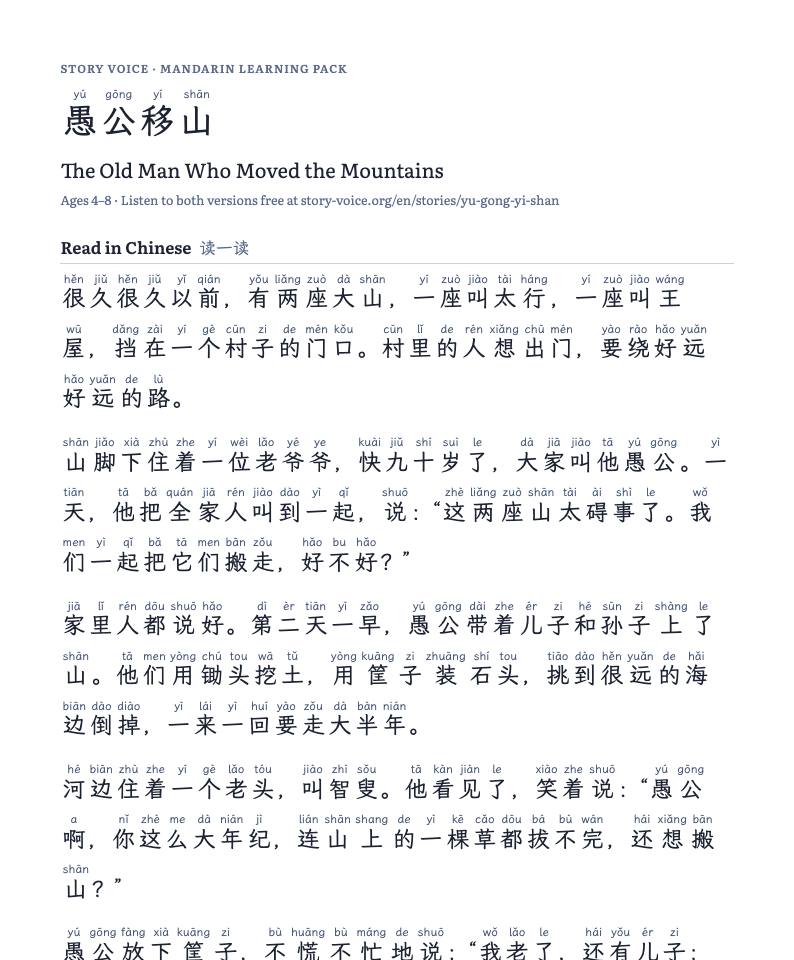
很久很久以前,有两座大山,一座叫太行,一座叫王屋,挡在一个村子的门口。村里的人想出门,要绕好远好远的路。
山脚下住着一位老爷爷,快九十岁了,大家叫他愚公。一天,他把全家人叫到一起,说:“这两座山太碍事了。我们一起把它们搬走,好不好?”
家里人都说好。第二天一早,愚公带着儿子和孙子上了山。他们用锄头挖土,用筐子装石头,挑到很远的海边倒掉,一来一回要走大半年。
河边住着一个老头,叫智叟。他看见了,笑着说:“愚公啊,你这么大年纪,连山上的一棵草都拔不完,还想搬山?”
愚公放下筐子,不慌不忙地说:“我老了,还有儿子;儿子老了,还有孙子;子子孙孙,没有完的时候。可是山不会再长高,怎么会搬不完呢?”小孙子也举起小手说:“我长大了也来搬!”智叟听了,一句话也说不出来。
这件事让天帝知道了。天帝很感动,说:“这一家人真有恒心!”他派了两个大力神,把两座大山背走了,一座放到东边,一座放到南边。
从那以后,村子门口的路又平又直,再也不用绕远了。
The Old Man Who Moved the Mountains (愚公移山): the moral of the story
No job is too big if you keep at it day after day. People may laugh, but what matters is that you don’t stop.
- What does The Old Man Who Moved the Mountains mean?
- Literally “Yugong moves the mountains”: 愚公 (Yú gōng) the foolish old man, 移 (yí) move, 山 (shān) mountain. It describes patient, stubborn determination to finish an enormous task, however long it takes.
- Example sentence
- Building that huge block castle will take days. Let’s be like Yugong, 愚公移山 (Yú gōng yí shān): a little every day, and one day it will be done.
The original Chinese text of The Old Man Who Moved the Mountains
太形、王屋二山,方七百里,高万仞。本在冀州之南,河阳之北。北山愚公者,年且九十,面山而居。
— 《列子·汤问》
Our translation
The two mountains Taixing and Wangwu were seven hundred li around and ten thousand ren high. They once stood south of Jizhou and north of Heyang. Yugong of the North Mountain was nearly ninety years old and lived facing the mountains.
— Liezi, “Tang Wen” (Warring States to Han, c. 4th century BC–3rd century AD)
Chinese words in The Old Man Who Moved the Mountains
Play the Chinese narration and listen for these words. The pinyin shows the tones.
愚公yú gōng
Yugong, the foolish old man
山shān
mountain
搬bān
to move, to carry
锄头chú tou
hoe
筐子kuāng zi
basket
孙子sūn zi
grandson
天帝tiān dì
the God of the Sky
恒心héng xīn
perseverance
For families learning Mandarin
Mandarin learning pack
Print the story, read it together, then listen and say it back. Made for heritage families and children learning Mandarin.
- A printable PDF (4 pages): the Chinese story with pinyin over every character, the words to know, the English version, questions to talk about, and character writing practice.
- Slow Mandarin audio (4 min): every sentence at a gentler pace, followed by a pause long enough to say it back.
Buy once, download again any time. The story itself stays free to read and hear. Try the free sample pack (The Tortoise and the Hare) first.
Bedtime storytelling tips
- Give Zhisou a mocking, know-it-all voice and Yugong a slow, calm one. The contrast is the whole point of the story.
- Count the generations on your fingers with your child: me, my sons, my grandsons, their sons… and then ask, “Do the mountains ever grow?”
- The key Chinese word is 搬 (bān), to move or carry. Let your child shout “I will dig too!” with the little grandson, in English or in Chinese: 我也来搬 (wǒ yě lái bān).
Things to talk about afterwards
- Why did Yugong want to move the mountains?
- Zhisou laughed at Yugong. What did Yugong say back to him?
- Is there something big that you would like to do? What is the first small step?
Read this story to your child in your own voice
- Record your voice and confirm it's really you
- Pick any story, in English or Chinese
- A few minutes later, hear it in your voice; you can also download the MP3
From about $1.05 a story, or $1.99 for a first-order taster. Reading and listening are always free, and failed generations are refunded.
The Old Man Who Moved the Mountains (愚公移山): common questions
- What is the moral of The Old Man Who Moved the Mountains?
- Keep going, one basket at a time, and even a mountain can be moved. Yugong is not put off by the size of the job or by Zhisou’s laughter, because he knows his family will carry on after him. In the end even the God of the Sky is moved by their determination.
- Where does the story of Yugong come from?
- It comes from the Liezi, chapter “Tang Wen,” a Daoist text attributed to Lie Yukou of the Warring States period. Mao Zedong retold it in a famous 1945 speech, which is one reason 愚公移山 is among the best-known idioms in China today.
- What does 愚公移山 mean?
- 愚公移山 (Yú gōng yí shān) means “the foolish old man moves the mountains.” 愚公 is the old man’s nickname, the foolish old man, and 智叟 (Zhì sǒu), the neighbour, means the wise old man. The story turns the names around: the “foolish” man is the one who is right. Today the idiom describes dogged determination to finish a huge task.
- Is there a Chinese version of The Old Man Who Moved the Mountains?
- Yes. It is called 愚公移山 (Yú gōng yí shān). This page has our Chinese retelling with Mandarin narration next to the English one, and the opening lines of the classical original.
Source and how we retold it
From the Liezi (列子), chapter “Tang Wen” (汤问). The book is attributed to Lie Yukou of the Warring States period, though the text we have was probably put together between the Han dynasty and the 3rd or 4th century AD; it is in the public domain. We retold it for children, leaving out Yugong’s wife raising doubts and the neighbour’s boy who comes to help, and simplifying the exchange between Yugong and Zhisou. The ending, where the God of the Sky sends two giants to carry the mountains away, is the original one.
The narration on this page is AI-generated: the English is read by our narrator and the Chinese by our narrator. The audio files are labeled as AI-generated.
If you liked The Old Man Who Moved the Mountains (愚公移山), there are more stories in Chinese Myths and Legends for Kids. You can also read this one to your child in your own voice.
More Chinese Myths and Legends for Kids
- Chinese Myths and Legends for KidsAges 3-62 min
The Race of the Twelve Zodiac Animals十二生肖的故事
The Jade Emperor holds a race to pick the twelve animals of the Chinese zodiac. Rat rides across the river on Ox and jumps off to come first, while Cat sleeps through it all. The folk tale behind the Chinese zodiac in simple English with narration, plus the Chinese version in Mandarin.
- Chinese Myths and Legends for KidsAges 5-92 min
Yu the Great Tames the Flood大禹治水
When a great flood covers the land, Yu digs channels to lead the water to the sea instead of blocking it. Three times he passes his own door without going in, and after thirteen years the rivers run to the sea. A Chinese legend from the Records of the Grand Historian in simple English with narration, plus the Chinese version in Mandarin.
- Chinese Myths and Legends for KidsAges 4-81 min
Sima Guang Breaks the Water Jar司马光砸缸
A little girl falls into a huge water jar and the other children run, but seven-year-old Sima Guang picks up a stone and breaks the jar so the water pours out. A true story from the History of Song, in simple English with narration, plus the Chinese version in Mandarin.
- Chinese Myths and Legends for KidsAges 4-82 min
Kuafu Chases the Sun夸父追日
The giant Kuafu runs after the sun, drinks two rivers dry and lies down to rest, and his staff grows into a forest of peach trees. A Chinese myth from the Shanhaijing in simple English with narration, plus the Chinese version in Mandarin.
- Chinese Myths and Legends for KidsAges 3-72 min
Pangu Separates Sky and Earth盘古开天地
Before there was a world, there was an egg, and inside it slept the giant Pangu. He splits the egg with his axe, holds up the sky for eighteen thousand years, and becomes the sun, the moon and the mountains. A Chinese creation myth in simple English with narration, plus the Chinese version in Mandarin.
- Chinese Myths and Legends for KidsAges 3-62 min
The Nian Monster and the New Year年兽的故事
Every New Year's Eve the monster Nian comes down from the mountains, until an old man shows a village that it fears red, fire and loud noise. The legend behind red paper, lanterns and firecrackers, in simple English with narration, plus the Chinese version in Mandarin.