The Blind Men and the Elephant (盲人摸象)
- Ages 4–8
- English audio 2 min
- Mandarin audio 2 min
The Blind Men and the Elephant is a classic story from Chinese Idiom Stories for Kids, for children aged 4–8. This page has the English story with a native English narration (about 2 min), plus the Chinese version with Mandarin narration (about 2 min). Free to read and listen, no sign-up.
A king asks some blind men to touch an elephant and say what it is like. One says a radish, one a fan, one a pillar, and they all argue. The parable behind the Chinese idiom 盲人摸象, in simple English and Chinese, with narration.
Tap any sentence in the story to start reading from there. It stops at the end.
A narrator, and a voice of its own for each character: The Elephant, The First Man, The Second Man, The Third Man, The King
Record about a minute of your voice, and every story here can be read to your child in it. Credits come back automatically if it fails.
Read The Blind Men and the Elephant
Long ago, a king wanted to play a little game. He had an elephant brought into the yard and asked some blind men to touch it and say what it was like.
The elephant swung its trunk. "Whoo!" The blind men put out their hands.
The first man touched the tusk. It was long and smooth. "I know! An elephant is like a big radish!"
The second man touched an ear. It was thin and wide. "No, no! An elephant is like a big fan!"
The third man hugged a leg. It was thick and round. "You are both wrong! An elephant is like a pillar!"
The three men argued until their faces went red. The king smiled. "You are all right, and all wrong. Each of you touched only one part."
The men went quiet. They felt the elephant again, slowly, from head to tail. Now they laughed. An elephant was so big! A tusk like a radish, an ear like a fan and legs like pillars.
The Chinese version: 盲人摸象
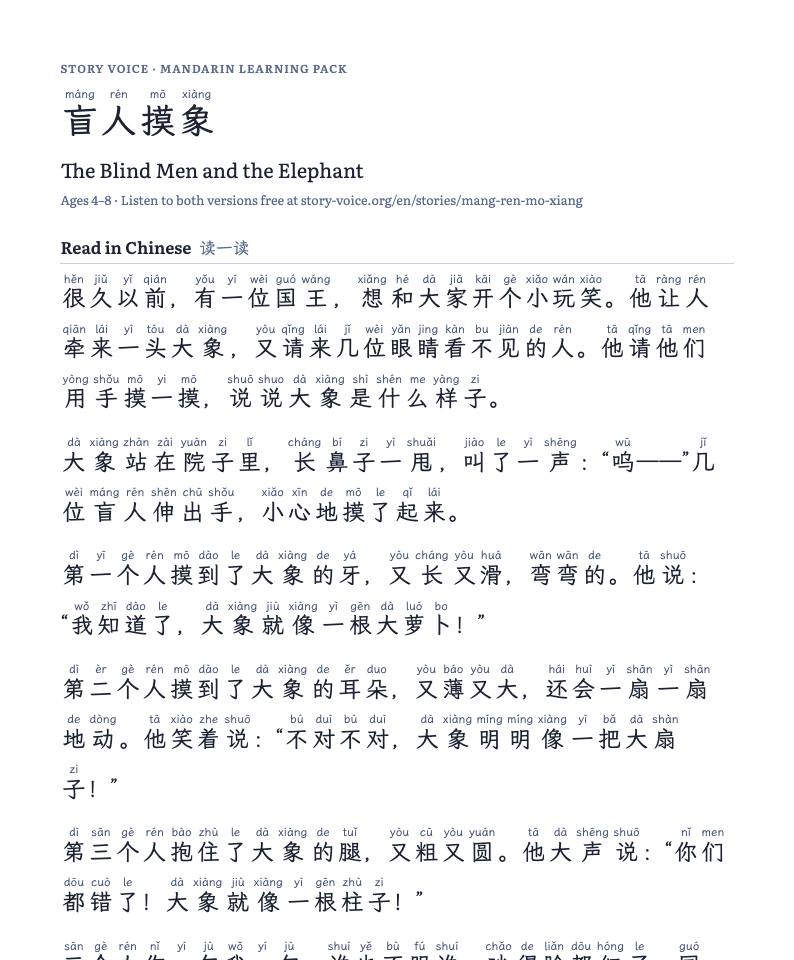
很久以前,有一位国王,想和大家开个小玩笑。他让人牵来一头大象,又请来几位眼睛看不见的人。他请他们用手摸一摸,说说大象是什么样子。
大象站在院子里,长鼻子一甩,叫了一声:“呜——”几位盲人伸出手,小心地摸了起来。
第一个人摸到了大象的牙,又长又滑,弯弯的。他说:“我知道了,大象就像一根大萝卜!”
第二个人摸到了大象的耳朵,又薄又大,还会一扇一扇地动。他笑着说:“不对不对,大象明明像一把大扇子!”
第三个人抱住了大象的腿,又粗又圆。他大声说:“你们都错了!大象就像一根柱子!”
三个人你一句我一句,谁也不服谁,吵得脸都红了。国王在旁边听着,笑了:“你们说的都对,又都不全对。你们每个人只摸到了大象的一小块呀。”
三个人安静下来,又伸出手,从头到尾慢慢地摸了一遍。这一回,他们都笑了。原来大象这么大,有萝卜一样的牙,扇子一样的耳朵,还有柱子一样的腿呢。
The Blind Men and the Elephant (盲人摸象): the moral of the story
When you have only felt one part, don’t say you know the whole. Feel a little more, and listen to what others found.
- What does The Blind Men and the Elephant mean?
- Literally “blind (盲, máng) people (人, rén) feel (摸, mō) an elephant (象, xiàng).” It describes someone who has seen only one part and thinks it is the whole, so their view is partial and one-sided.
- Example sentence
- He read one page and said the whole book was boring. That’s 盲人摸象 (máng rén mō xiàng): you have to read more before you can say.
The original Chinese text of The Blind Men and the Elephant
其触牙者即言象形如芦菔根,其触耳者言象如箕,其触头者言象如石,其触鼻者言象如杵。
— 《大般涅槃经·师子吼菩萨品》
Our translation
The one who touched the tusk said the elephant was shaped like a radish root; the one who touched the ear said it was like a winnowing basket; the one who touched the head said it was like a rock; the one who touched the trunk said it was like a pestle.
— Mahāparinirvāṇa Sūtra, “Bodhisattva Lion’s Roar” (Chinese translation, early 5th century)
Chinese words in The Blind Men and the Elephant
Play the Chinese narration and listen for these words. The pinyin shows the tones.
盲人摸象máng rén mō xiàng
blind men feel an elephant
大象dà xiàng
elephant
摸mō
touch, feel
牙yá
tusk, tooth
耳朵ěr duo
ear
扇子shàn zi
fan
柱子zhù zi
pillar
国王guó wáng
king
For families learning Mandarin
Mandarin learning pack
Print the story, read it together, then listen and say it back. Made for heritage families and children learning Mandarin.
- A printable PDF (3 pages): the Chinese story with pinyin over every character, the words to know, the English version, questions to talk about, and character writing practice.
- Slow Mandarin audio (4 min): every sentence at a gentler pace, followed by a pause long enough to say it back.
Buy once, download again any time. The story itself stays free to read and hear. Try the free sample pack (The Tortoise and the Hare) first.
Bedtime storytelling tips
- Give the three men three different voices, one slow, one gruff, one in a hurry. The argument is the funniest part.
- As each man touches a part, let your child close their eyes and feel your arm or your ear and guess what it is.
- Pause after the king speaks and ask: “So what is an elephant like?” Let your child name all three things. In Chinese, elephant is 大象 (dà xiàng).
Things to talk about afterwards
- Which part of the elephant did each man touch? What did they say it was like?
- Why did the men argue? What did the king tell them?
- Have you ever been sure about something after seeing only a little of it? What happened next?
Read this story to your child in your own voice
- Record your voice and confirm it's really you
- Pick any story, in English or Chinese
- A few minutes later, hear it in your voice; you can also download the MP3
From about $1.05 a story, or $1.99 for a first-order taster. Reading and listening are always free, and failed generations are refunded.
The Blind Men and the Elephant (盲人摸象): common questions
- What does the Chinese idiom 盲人摸象 mean?
- 盲人摸象 (máng rén mō xiàng) means “blind men feel an elephant.” It describes judging a whole thing from one small part, or an opinion that is true about one piece and wrong about the rest.
- What is the moral of The Blind Men and the Elephant?
- Each man was right about the part he touched and wrong about the whole. The story asks us to look further and to put what others found together with what we found.
- Where does The Blind Men and the Elephant come from?
- It is an old Buddhist parable from India. In Chinese it is best known from the Mahāparinirvāṇa Sūtra (大般涅槃经), translated in the early 5th century, and a version is also in the Dīrgha Āgama (长阿含经). The poem by John Godfrey Saxe later made it famous in English.
- Is there a Chinese version of The Blind Men and the Elephant?
- Yes. It is called 盲人摸象 (máng rén mō xiàng). This page has our Chinese retelling with Mandarin narration next to the English one, and the classical original with a translation.
Source and how we retold it
A Buddhist parable, told in the Mahāparinirvāṇa Sūtra, chapter “Bodhisattva Lion’s Roar” (大般涅槃经·师子吼菩萨品, Chinese translation by Dharmakṣema, early 5th century) and, in another form, in the Dīrgha Āgama (长阿含经); the texts are in the public domain. In the original a king has each blind man touch one part: the tusk is like a radish root, the ear like a winnowing basket, the head like a rock, the trunk like a pestle, and so on. We kept three men (tusk, ear and leg), turned the basket into a fan that children know, gave the elephant a trumpet, and added a gentle ending where the king lets them feel the whole elephant.
The narration on this page is AI-generated: the English is read by our narrator and the Chinese by our narrator. The audio files are labeled as AI-generated.
If you liked The Blind Men and the Elephant (盲人摸象), there are more stories in Chinese Idiom Stories for Kids. You can also read this one to your child in your own voice.
More Chinese Idiom Stories for Kids
- Chinese Idiom Stories for KidsAges 4-82 min
Playing the Lute to a Cow对牛弹琴
A master musician plays his finest tune to a cow, and the cow just chews. Then he plays the buzz of a mosquito and the cry of a calf, and her ears go up. The Chinese idiom story 对牛弹琴 in simple English and Chinese, with narration.
- Chinese Idiom Stories for KidsAges 4-82 min
Marking the Boat to Find the Sword刻舟求剑
A man drops his sword into a river, cuts a mark on the moving boat, and jumps in under the mark once the boat lands. The idiom story 刻舟求剑 in English and Chinese, with narration.
- Chinese Idiom Stories for KidsAges 4-82 min
The Fox Borrows the Tiger's Power狐假虎威
A tiger catches a fox, and the fox claims Heaven made him king of the animals. He walks ahead, the tiger follows, and every animal runs. The idiom story 狐假虎威 in English and Chinese, with narration.
- Chinese Idiom Stories for KidsAges 4-82 min
Mending the Pen After Losing a Sheep亡羊补牢
A shepherd loses a sheep through a hole in his pen but won’t fix it. When a second sheep goes, he mends it at once. The idiom story 亡羊补牢 in English and Chinese, with narration.
- Chinese Idiom Stories for KidsAges 4-82 min
Drawing Legs on a Snake画蛇添足
Helpers race to draw a snake for a pot of honey water. The fastest one finishes, then adds feet to his snake and loses the prize. The idiom story 画蛇添足 in English and Chinese, with narration.
- Chinese Idiom Stories for KidsAges 4-82 min
Waiting by the Tree Stump守株待兔
A farmer gets a free rabbit when it runs into a tree stump, so he stops working and waits by the stump for another. The idiom story 守株待兔 in English and Chinese, with narration.