Faking It in the Orchestra (滥竽充数)
- Ages 4–8
- English audio 1 min
- Mandarin audio 2 min
Faking It in the Orchestra is a classic story from Chinese Idiom Stories for Kids, for children aged 4–8. This page has the English story with a native English narration (about 1 min), plus the Chinese version with Mandarin narration (about 2 min). Free to read and listen, no sign-up.
Mr Nanguo can’t play a note, but he hides among three hundred pipers and gets paid for years, until a new king wants to hear them one by one. The Chinese idiom story 滥竽充数 in simple English and Chinese, with narration.
Tap any sentence in the story to start reading from there. It stops at the end.
A narrator, and a voice of its own for each character: Mr Nanguo, King Xuan, The Young Player, King Min
Record about a minute of your voice, and every story here can be read to your child in it. Credits come back automatically if it fails.
Read Faking It in the Orchestra
Long ago, King Xuan of Qi loved the yu, a pipe made of bamboo. It hummed like a hundred bees.
He liked it loud, and always wanted three hundred players at once.
Mr Nanguo could not play at all. But he went to the palace and said, "Your Majesty, I play beautifully. Let me join!" The king was pleased. "Good! Stand with the others."
Mr Nanguo stood in the middle of the band. When the others puffed out their cheeks, so did he. But his pipe never made a sound. A young player whispered, "Why can't I hear you?" Mr Nanguo winked. "Shh! Who can tell?"
He was paid like everyone else, and stayed for years.
Then King Xuan gave the crown to his son, King Min, who said, "Three hundred at once is too loud. I want to hear them one by one."
Mr Nanguo was scared. The night before his turn, he packed his bag and slipped away. If only he had learned to play!
The Chinese version: 滥竽充数
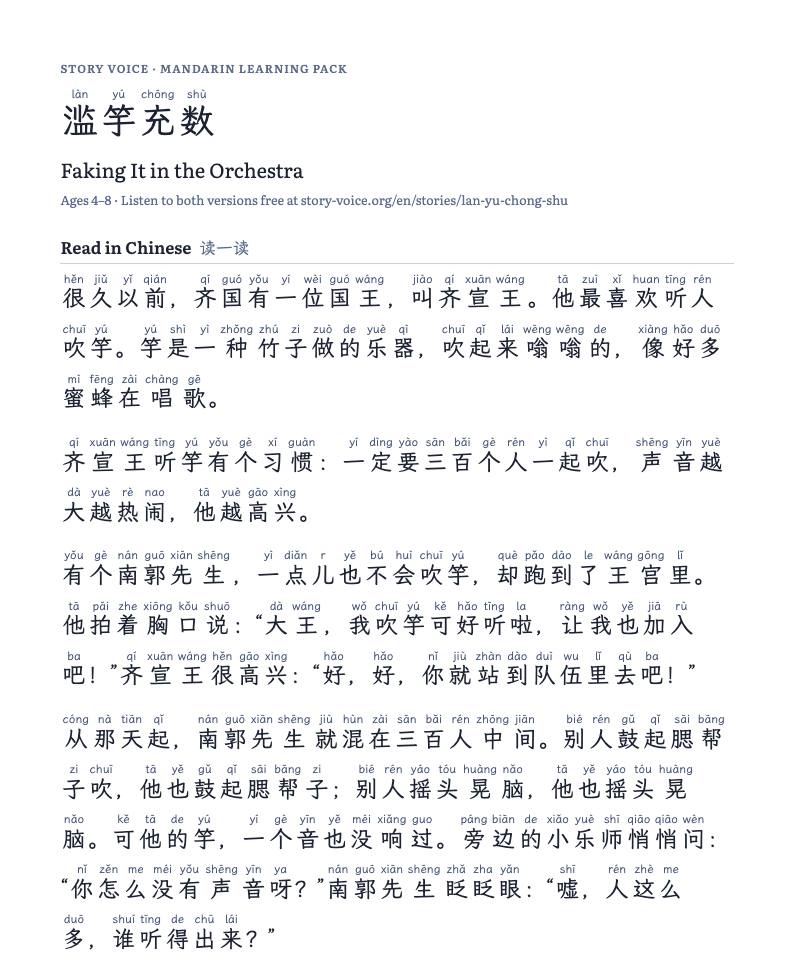
很久以前,齐国有一位国王,叫齐宣王。他最喜欢听人吹竽。竽是一种竹子做的乐器,吹起来嗡嗡的,像好多蜜蜂在唱歌。
齐宣王听竽有个习惯:一定要三百个人一起吹,声音越大越热闹,他越高兴。
有个南郭先生,一点儿也不会吹竽,却跑到了王宫里。他拍着胸口说:“大王,我吹竽可好听啦,让我也加入吧!”齐宣王很高兴:“好,好,你就站到队伍里去吧!”
从那天起,南郭先生就混在三百人中间。别人鼓起腮帮子吹,他也鼓起腮帮子;别人摇头晃脑,他也摇头晃脑。可他的竽,一个音也没响过。旁边的小乐师悄悄问:“你怎么没有声音呀?”南郭先生眨眨眼:“嘘,人这么多,谁听得出来?”
就这样,南郭先生领着和大家一样多的粮食和工钱,一混就是好多年。
后来,齐宣王年纪大了,把王位传给了儿子齐湣王。齐湣王也爱听竽,可是他说:“三百个人一起吹,太吵了。我要一个一个地听。”
这下南郭先生慌了。轮到他的前一天晚上,他收拾好包袱,悄悄地溜走了。其实呀,要是他早一点好好学吹竽,说不定真能吹得很好听呢。
Faking It in the Orchestra (滥竽充数): the moral of the story
Pretending to have a skill works only until someone looks closely. Real skill is learned a little at a time.
- What does Faking It in the Orchestra mean?
- Literally “a poor (滥, làn) yu-player (竽, yú) filling up (充, chōng) the numbers (数, shù).” It describes someone with no real skill who hides among experts and gets by, or a poor thing passed off as a good one. People also say it modestly about themselves, like “I’m only here to make up the numbers.”
- Example sentence
- At the choir contest, Gang didn’t know the words, so he opened and closed his mouth without singing. The teacher said that was 滥竽充数 (làn yú chōng shù), and everyone had to practise properly.
The original Chinese text of Faking It in the Orchestra
齐宣王使人吹竽,必三百人。南郭处士请为王吹竽,宣王说之,廪食以数百人。宣王死,湣王立,好一一听之,处士逃。
— 《韩非子·内储说上》
Our translation
King Xuan of Qi had men play the yu for him, and there always had to be three hundred of them. A gentleman from Nanguo asked to play for the king; the king was delighted, and fed him as he fed the hundreds of others. When King Xuan died and King Min came to the throne, the new king liked to hear the players one by one, and the gentleman fled.
— Han Feizi, “Inner Collection of Sayings, Part One” (3rd century BC)
Chinese words in Faking It in the Orchestra
Play the Chinese narration and listen for these words. The pinyin shows the tones.
滥竽充数làn yú chōng shù
make up the numbers without real skill
竽yú
yu, a bamboo pipe
吹chuī
blow, play a pipe
国王guó wáng
king
乐师yuè shī
musician
装样子zhuāng yàng zi
pretend, put on an act
溜走liū zǒu
slip away
本事běn shi
skill
For families learning Mandarin
Mandarin learning pack
Print the story, read it together, then listen and say it back. Made for heritage families and children learning Mandarin.
- A printable PDF (4 pages): the Chinese story with pinyin over every character, the words to know, the English version, questions to talk about, and character writing practice.
- Slow Mandarin audio (4 min): every sentence at a gentler pace, followed by a pause long enough to say it back.
Buy once, download again any time. The story itself stays free to read and hear. Try the free sample pack (The Tortoise and the Hare) first.
Bedtime storytelling tips
- When the three hundred pipers play, puff out your cheeks and hum together, then point out in a whisper that Mr Nanguo isn’t making a sound.
- Say “Shh! Who can tell?” with a wink and a low voice. Children find Mr Nanguo funny and a little bit sad at the same time.
- Pause when the new king wants to hear the players one by one and ask: “What should Mr Nanguo do?” In Chinese, the pipe is a 竽 (yú).
Things to talk about afterwards
- Could Mr Nanguo play the yu? How did he hide in the band?
- Why was Mr Nanguo scared when the new king wanted to hear them one by one?
- What could Mr Nanguo have done instead of running away?
Read this story to your child in your own voice
- Record your voice and confirm it's really you
- Pick any story, in English or Chinese
- A few minutes later, hear it in your voice; you can also download the MP3
From about $1.05 a story, or $1.99 for a first-order taster. Reading and listening are always free, and failed generations are refunded.
Faking It in the Orchestra (滥竽充数): common questions
- What does the Chinese idiom 滥竽充数 mean?
- 滥竽充数 (làn yú chōng shù) literally means “a poor yu-player filling up the numbers.” It describes someone without real skill who hides among experts to make up the numbers, or something second-rate passed off as good. People also use it modestly about themselves: “I’m just here to make up the numbers.”
- What is the moral of Faking It in the Orchestra?
- Faking a skill may work while nobody looks closely, but sooner or later you have to play alone. Mr Nanguo would have been far better off learning to play.
- Where does 滥竽充数 come from?
- From the Han Feizi, a book of political philosophy by Han Fei, written at the end of the Warring States period (3rd century BC). Han Fei used the story to argue that a ruler should test his officials one by one.
- Is there a Chinese version of Faking It in the Orchestra?
- Yes. It is called 滥竽充数 (làn yú chōng shù). This page has our Chinese retelling with Mandarin narration next to the English one, and the classical original with a translation.
Source and how we retold it
From the Han Feizi, chapter “Inner Collection of Sayings, Part One” (内储说上), written by Han Fei in the 3rd century BC; the original is in the public domain. We expanded the few lines of the original into a story for children, adding Mr Nanguo’s play-acting and the young player beside him. Where the original says King Xuan died and King Min took the throne, we say the old king passed the crown to his son, and we added a last line wishing Mr Nanguo had simply learned to play.
The narration on this page is AI-generated: the English is read by our narrator and the Chinese by our narrator. The audio files are labeled as AI-generated.
If you liked Faking It in the Orchestra (滥竽充数), there are more stories in Chinese Idiom Stories for Kids. You can also read this one to your child in your own voice.
More Chinese Idiom Stories for Kids
- Chinese Idiom Stories for KidsAges 4-82 min
The Blind Men and the Elephant盲人摸象
A king asks some blind men to touch an elephant and say what it is like. One says a radish, one a fan, one a pillar, and they all argue. The parable behind the Chinese idiom 盲人摸象, in simple English and Chinese, with narration.
- Chinese Idiom Stories for KidsAges 4-82 min
Playing the Lute to a Cow对牛弹琴
A master musician plays his finest tune to a cow, and the cow just chews. Then he plays the buzz of a mosquito and the cry of a calf, and her ears go up. The Chinese idiom story 对牛弹琴 in simple English and Chinese, with narration.
- Chinese Idiom Stories for KidsAges 4-82 min
Marking the Boat to Find the Sword刻舟求剑
A man drops his sword into a river, cuts a mark on the moving boat, and jumps in under the mark once the boat lands. The idiom story 刻舟求剑 in English and Chinese, with narration.
- Chinese Idiom Stories for KidsAges 4-82 min
The Fox Borrows the Tiger's Power狐假虎威
A tiger catches a fox, and the fox claims Heaven made him king of the animals. He walks ahead, the tiger follows, and every animal runs. The idiom story 狐假虎威 in English and Chinese, with narration.
- Chinese Idiom Stories for KidsAges 4-82 min
Mending the Pen After Losing a Sheep亡羊补牢
A shepherd loses a sheep through a hole in his pen but won’t fix it. When a second sheep goes, he mends it at once. The idiom story 亡羊补牢 in English and Chinese, with narration.
- Chinese Idiom Stories for KidsAges 4-82 min
Drawing Legs on a Snake画蛇添足
Helpers race to draw a snake for a pot of honey water. The fastest one finishes, then adds feet to his snake and loses the prize. The idiom story 画蛇添足 in English and Chinese, with narration.