The Old Man Who Lost His Horse (塞翁失马)
- Ages 4–8
- English audio 2 min
- Mandarin audio 2 min
The Old Man Who Lost His Horse is a classic story from Chinese Idiom Stories for Kids, for children aged 4–8. This page has the English story with a native English narration (about 2 min), plus the Chinese version with Mandarin narration (about 2 min). Free to read and listen, no sign-up.
An old man loses his horse, and everyone says it is bad luck. He only says, “Maybe.” The Chinese idiom story 塞翁失马 in simple English and Chinese, with narration.
Tap any sentence in the story to start reading from there. It stops at the end.
A narrator, and a voice of its own for each character: Sai Weng, The Neighbours, The Son
Record about a minute of your voice, and every story here can be read to your child in it. Credits come back automatically if it fails.
Read The Old Man Who Lost His Horse
Long ago, an old man lived near the northern border. People called him Sai Weng. He had one horse.
One day the horse ran away. The neighbours came to comfort him. "What bad luck!" Sai Weng smiled. "Losing a horse may not be a bad thing."
Months later, the horse came home with a fine tall horse behind it. "What good luck!" said the neighbours. "Getting a horse may not be a good thing," said Sai Weng.
His son rode the new horse every day. "Father, look how fast it runs!" One day he fell off and hurt his leg.
The neighbours came again. "This may not be a bad thing," said Sai Weng.
Soon there was a war, and the young men were called away to be soldiers. Sai Weng's son, with his hurt leg, stayed safe at home.
Now the neighbours understood. Bad luck can turn into good, and good luck into bad. "So don't be too sad, and don't be too proud," said Sai Weng.
The Chinese version: 塞翁失马
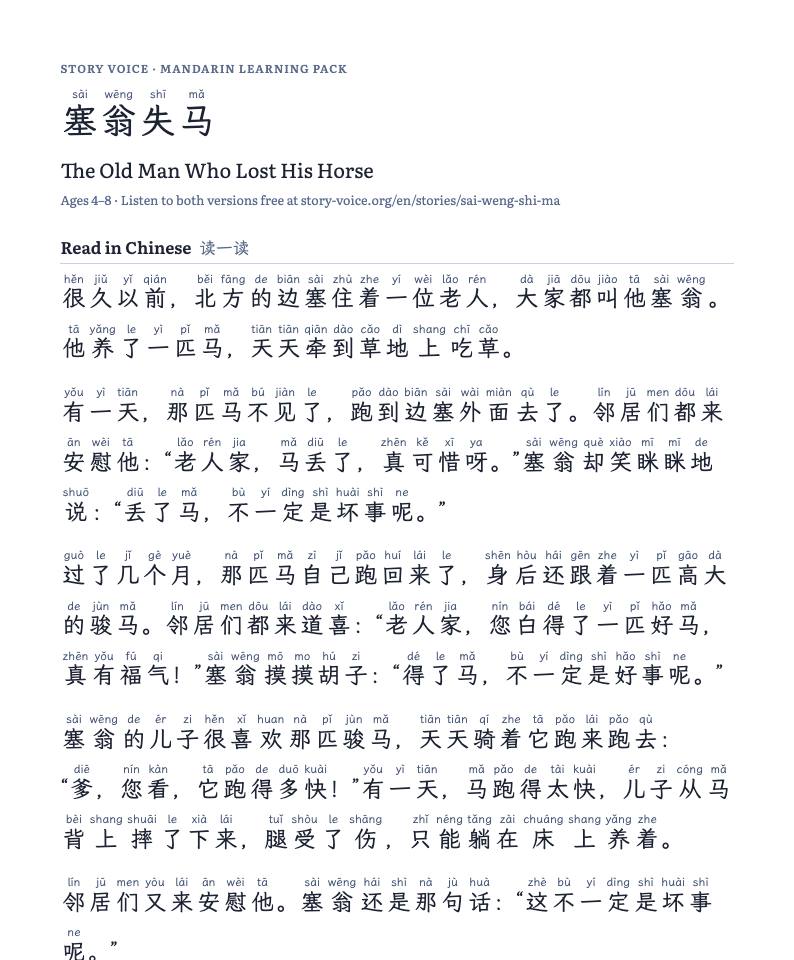
很久以前,北方的边塞住着一位老人,大家都叫他塞翁。他养了一匹马,天天牵到草地上吃草。
有一天,那匹马不见了,跑到边塞外面去了。邻居们都来安慰他:“老人家,马丢了,真可惜呀。”塞翁却笑眯眯地说:“丢了马,不一定是坏事呢。”
过了几个月,那匹马自己跑回来了,身后还跟着一匹高大的骏马。邻居们都来道喜:“老人家,您白得了一匹好马,真有福气!”塞翁摸摸胡子:“得了马,不一定是好事呢。”
塞翁的儿子很喜欢那匹骏马,天天骑着它跑来跑去:“爹,您看,它跑得多快!”有一天,马跑得太快,儿子从马背上摔了下来,腿受了伤,只能躺在床上养着。
邻居们又来安慰他。塞翁还是那句话:“这不一定是坏事呢。”
没过多久,边塞上有了战事,村里的年轻人都被叫去当兵,离家很远,吃了不少苦。塞翁的儿子因为腿还没好,留在了家里,陪着父亲平平安安地过日子。
邻居们这才明白:坏事可能变成好事,好事也可能变成坏事。塞翁慢慢地说:“所以呀,碰到坏事别太难过,碰到好事也别太得意。”
The Old Man Who Lost His Horse (塞翁失马): the moral of the story
Don’t be too sad about bad luck or too proud of good luck. Things often turn out differently from how they look at first.
- What does The Old Man Who Lost His Horse mean?
- Literally “the old man at the border (塞翁, sài wēng) lost (失, shī) his horse (马, mǎ).” It is usually completed with 焉知非福, “who knows it isn’t a blessing?” It means that bad luck can turn into good luck, and good luck into bad, so don’t judge too soon. The closest English saying is “a blessing in disguise.”
- Example sentence
- It rained, so Ming couldn’t go to the park. He was sad, but at home he learned to fold a paper boat. That’s 塞翁失马 (sài wēng shī mǎ): the bad luck turned into something good.
The original Chinese text of The Old Man Who Lost His Horse
近塞上之人有善术者,马无故亡而入胡。人皆吊之,其父曰:‘此何遽不为福乎?’居数月,其马将胡骏马而归。
— 《淮南子·人间训》
Our translation
Near the border lived a man skilled in the arts of fortune. His horse ran off for no reason into the land of the Hu. Everyone came to console him, but the old man said, “How do you know this is not a blessing?” A few months later, the horse came back, bringing a fine Hu horse with it.
— Huainanzi, “Among Men” (2nd century BC)
Chinese words in The Old Man Who Lost His Horse
Play the Chinese narration and listen for these words. The pinyin shows the tones.
塞翁失马sài wēng shī mǎ
the old man at the border lost his horse
马mǎ
horse
邻居lín jū
neighbour
安慰ān wèi
comfort
骏马jùn mǎ
fine horse
摔shuāi
fall
受伤shòu shāng
get hurt
福气fú qi
good luck
For families learning Mandarin
Mandarin learning pack
Print the story, read it together, then listen and say it back. Made for heritage families and children learning Mandarin.
- A printable PDF (3 pages): the Chinese story with pinyin over every character, the words to know, the English version, questions to talk about, and character writing practice.
- Slow Mandarin audio (4 min): every sentence at a gentler pace, followed by a pause long enough to say it back.
Buy once, download again any time. The story itself stays free to read and hear. Try the free sample pack (The Tortoise and the Hare) first.
Bedtime storytelling tips
- Give Sai Weng one slow, smiling voice for every “may not be” line. By the third time, your child will say it with you.
- Read the neighbours’ first visit in a gloomy voice and the second in a cheerful one. The bigger the contrast, the better.
- Pause when the son hurts his leg and ask: “Is this good luck or bad luck?” Then read on. In Chinese, good luck is 福气 (fú qi).
Things to talk about afterwards
- When the horse ran away, what did the neighbours think? What did Sai Weng say?
- The son hurt his leg. Why did that turn out to be good luck?
- Has something bad ever happened to you that turned into something good?
Read this story to your child in your own voice
- Record your voice and confirm it's really you
- Pick any story, in English or Chinese
- A few minutes later, hear it in your voice; you can also download the MP3
From about $1.05 a story, or $1.99 for a first-order taster. Reading and listening are always free, and failed generations are refunded.
The Old Man Who Lost His Horse (塞翁失马): common questions
- What does the Chinese idiom 塞翁失马 mean?
- 塞翁失马 (sài wēng shī mǎ) means “the old man at the border lost his horse.” It is often followed by 焉知非福 (yān zhī fēi fú), “how do you know it isn’t a blessing?” Together they mean that bad luck can turn into good luck, and good into bad.
- What is the moral of The Old Man Who Lost His Horse?
- Don’t judge too quickly. Losing the horse looked bad but brought a second horse; the son’s fall looked bad but kept him safe at home. Be patient, and don’t be too sad or too proud.
- Where does 塞翁失马 come from?
- From the Huainanzi, a collection of essays compiled at the court of Liu An, Prince of Huainan, in the 2nd century BC. The story is in the chapter “Among Men” (人间训).
- Is there a Chinese version of The Old Man Who Lost His Horse?
- Yes. It is called 塞翁失马 (sài wēng shī mǎ). This page has our Chinese retelling with Mandarin narration next to the English one, and the classical original with a translation.
Source and how we retold it
From the Huainanzi, chapter “Among Men” (人间训), compiled in the 2nd century BC; the original is in the public domain. We retold the short classical text as a story for children, adding the son’s and the neighbours’ lines. The son’s fall is told gently (he hurt his leg and stayed home), and where the original says most of the young men who went to war did not come back, we only say they were called away and had a hard time.
The narration on this page is AI-generated: the English is read by our narrator and the Chinese by our narrator. The audio files are labeled as AI-generated.
If you liked The Old Man Who Lost His Horse (塞翁失马), there are more stories in Chinese Idiom Stories for Kids. You can also read this one to your child in your own voice.
More Chinese Idiom Stories for Kids
- Chinese Idiom Stories for KidsAges 4-81 min
Faking It in the Orchestra滥竽充数
Mr Nanguo can’t play a note, but he hides among three hundred pipers and gets paid for years, until a new king wants to hear them one by one. The Chinese idiom story 滥竽充数 in simple English and Chinese, with narration.
- Chinese Idiom Stories for KidsAges 4-82 min
The Blind Men and the Elephant盲人摸象
A king asks some blind men to touch an elephant and say what it is like. One says a radish, one a fan, one a pillar, and they all argue. The parable behind the Chinese idiom 盲人摸象, in simple English and Chinese, with narration.
- Chinese Idiom Stories for KidsAges 4-82 min
Playing the Lute to a Cow对牛弹琴
A master musician plays his finest tune to a cow, and the cow just chews. Then he plays the buzz of a mosquito and the cry of a calf, and her ears go up. The Chinese idiom story 对牛弹琴 in simple English and Chinese, with narration.
- Chinese Idiom Stories for KidsAges 4-82 min
Marking the Boat to Find the Sword刻舟求剑
A man drops his sword into a river, cuts a mark on the moving boat, and jumps in under the mark once the boat lands. The idiom story 刻舟求剑 in English and Chinese, with narration.
- Chinese Idiom Stories for KidsAges 4-82 min
The Fox Borrows the Tiger's Power狐假虎威
A tiger catches a fox, and the fox claims Heaven made him king of the animals. He walks ahead, the tiger follows, and every animal runs. The idiom story 狐假虎威 in English and Chinese, with narration.
- Chinese Idiom Stories for KidsAges 4-82 min
Mending the Pen After Losing a Sheep亡羊补牢
A shepherd loses a sheep through a hole in his pen but won’t fix it. When a second sheep goes, he mends it at once. The idiom story 亡羊补牢 in English and Chinese, with narration.